demand
- asset types
- money
- currency: coins, bills
- deposit accounts: bank deposits
- bonds: interest rate, not used for transactions
- money
- money vs bonds dependent on…
- level of transactions: need money on hand to avoid having to sell bonds, dependent on spending per month etc
- interest rate on bonds: holding wealth in bonds is for interest, hassle of managing bonds is dependent on rate
- money market funds pool funds of many people to buy bonds
- terms
- income: earning from work + interest, dividends; flow over time
- saving: after-tax income not spent
- wealth: value of all financial assets minus financial liabilities
- investment: purchase of new capital goods
derivation
- : amount of money people want to hold
- if nominal income increase, transactions increase proportional, increase proportional
- based on some function of interest rate,
- has negative relationship with
determining interest rate
-
focus on supply of money and equilibrium
-
in real world, two types of money: deposit accounts supplied by banks, currency supplied by central bank
-
assume deposit accounts do not exist, only money is currency
-
suppose central bank decides to supply money equal to , thus , for supply
-
equilibrium requires money supply equals demand, that
- so and
- shows that must be such that for given income people must be willing to hold money equal to existing money supply ; called the relationship
- i.e. increase to supply of money by central bank leads to decrease in interest rate
- decrease in interest rate leads to increased demand for money, so it equals increased money supply
open market operations
- central banks change supply of money by buying or selling bonds
- central banks wants increase, buys bond and pays for them by creating money; if wants to decrease, sells bonds and removes from circulation money in exchange for bonds
- called open market operations as they happen in ‘open market’ for bonds
- expansionary open market operation → expands supply of money
- contractionary open market operation → contracts supply of money
bond prices and yields
- suppose one-year bonds with payment of and some price ; interest rate given as
- price today from one-year bond paying year from today is
- central bank buys bonds → supply of bonds decreases (less fulfilled demand) → price increases → interest rate goes down
- central bank sells bonds → supply of bonds increases (more fulfilled demand) → price decreases → interest rate goes up
liquidity trap
- assume central bank could always affect interest rate by changing money supply
- however, interest rate cannot fall below zero
- as interest rate decreases, people want to hold more money + less bonds
- as interest rate becomes zero, people want to hold money equal to , i.e. right when it hit
adding deposit accounts
assets/liabilities
- central bank
- assets: bonds
- liabilities: central bank money (reserves + currency)
- banks
- assets: reserves, loans, bonds
- liabilities: deposit accounts
cont
- up to this point, assuming only currency supplied by central banks
- banks keep as reserves some funds they receive
-
- on given day some depositors withdraw, other deposit cash; no reason for inflows and outflows to be equal
-
- on given day, people with accounts write checks to other people with accounts; what bank owes to other banks can be larger or smaller than what is owed to it
-
- there are certain reserve requirements applied in areas (europe in this case, with a reserve ratio of 2% on certain deposit types
-
- loans represent most of banks’ non-reserve assets, bonds account for the rest
- bonds/loans are approximately equivalent in the model
- assume only reserves and bonds as assets
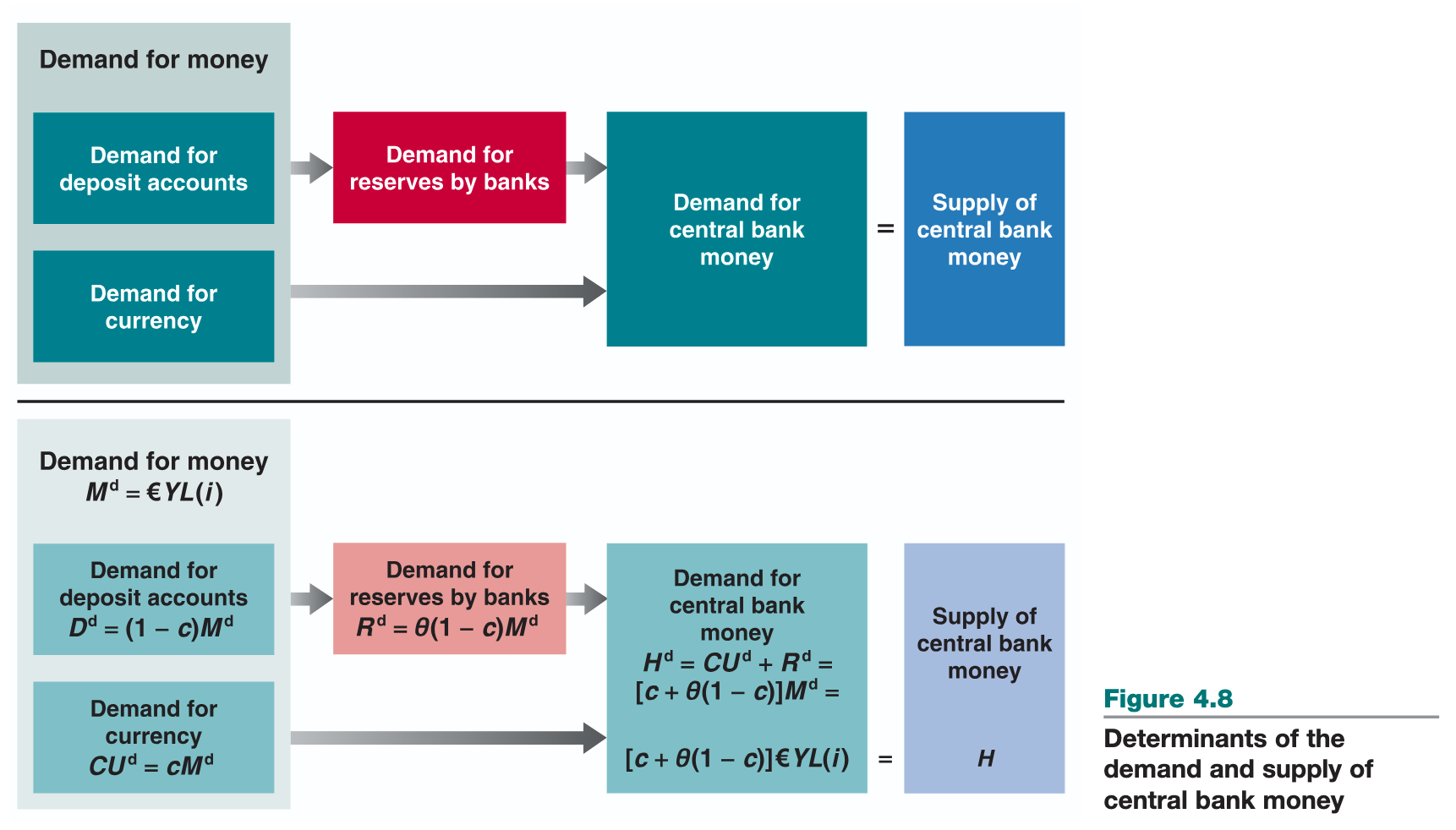
- demand for money
- what determines the demand for deposit accounts vs currency?
- in the equations, the vs factors, where is towards demand for currency
- what determines the demand for reserves by banks?
- based on the amount required by the country, e.g. 2%, and , the demand for deposit accounts
- what determines the demand for central bank money?
- based on a negative relationship with a function of interest
- how does the condition that demand/supply of central money be equal determine interest rate
- the demand is through , so if and are set, has to follow through